16x22x4 Air Filters and Energy Efficiency: What to Know
I didn't think a filter's thickness mattered until I checked my own system's static pressure rating and watched the number move. Here's the short answer: a 16x22x4 filter can improve HVAC energy efficiency, but only when it's solving a real airflow problem, not just because it's bigger. This page covers the airflow mechanics most filter-size guides skip entirely, when the upgrade actually pays off, and how to check whether your own system can even use one.
TL;DR
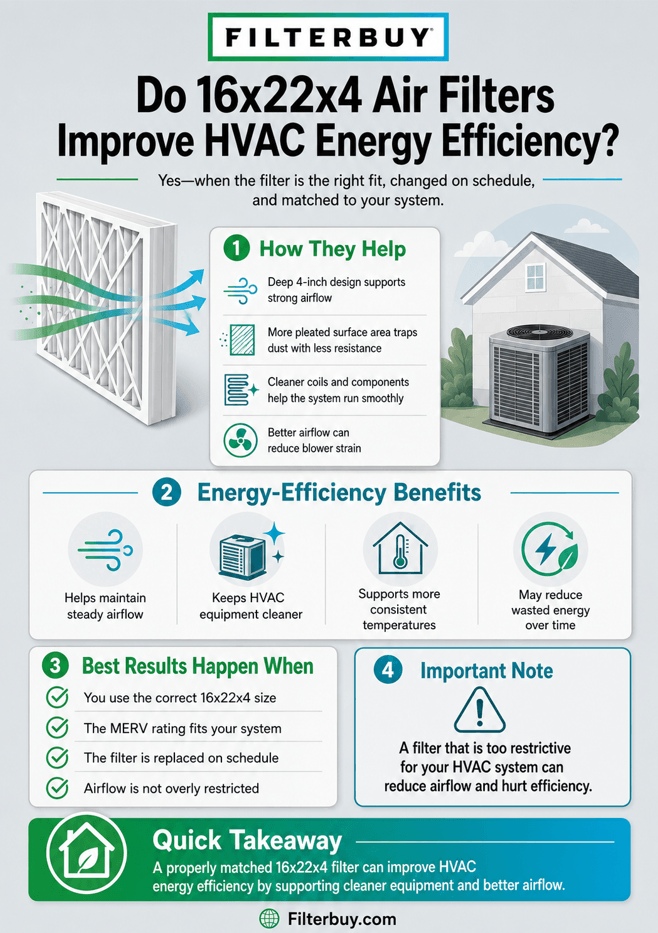
A 16x22x4 air filter can improve HVAC energy efficiency because its extra depth gives the pleats more surface area, so air moves through with less resistance than a thin 1-inch filter at the same or higher MERV rating. That lower resistance means my blower motor doesn't strain as hard, which is where the energy savings actually come from, not from the filter size itself.
Quick Answer
Switching from a 1-inch to a 16x22x4 filter doesn't automatically save energy, but it removes one of the most common causes of wasted energy: airflow resistance from an undersized, quickly-clogging filter. Since heating and cooling account for nearly half of a typical home's energy use, a filter that keeps airflow steady for longer directly protects that portion of my bill.
Key Takeaways
Heating and cooling make up close to half of a home's total energy use, so anything that makes the HVAC system work harder shows up on the utility bill fast.
A dirty or undersized filter is one of the most common causes of that extra strain, because restricted airflow forces the blower motor to work harder to move the same amount of air.
A 4-inch filter has far more pleated surface area than a 1-inch filter, which means air can pass through at a lower velocity and lower resistance for a comparable MERV rating.
Bigger surface area also means the filter holds more debris before it clogs, so a monthly filter check isn't required just to keep airflow where it should be.
Efficiency gains depend on matching the filter to what your system can actually handle, since going too high on MERV without the airflow to support it can undo the benefit.
Why Filter Depth Matters More Than People Think
When I first started looking into this, I assumed all air filters worked about the same and the only real choice was MERV rating. That's not quite right. According to the EPA, pleating a filter increases its surface area and reduces the velocity of air moving through the media, which lets the filter use finer fibers and denser packing without a big drop in airflow. A 4-inch filter has room for far more pleats than a 1-inch filter of the same face dimensions, so that surface-area advantage is much bigger. It's the same reason pleated filters generally outperform non-pleated filters on both capture and airflow, just taken a step further with depth.
In practical terms: air moving through more surface area at a lower velocity meets less resistance. Less resistance means my blower motor isn't fighting the filter to push air through the ducts. That's the actual mechanism behind any energy savings. It's airflow resistance, not the physical thickness of the filter, that drives the efficiency difference.
The Airflow-to-Energy Connection
Here's where I stopped taking the "bigger filter, better efficiency" claim at face value and actually checked the mechanism. ENERGY STAR is direct about this: nearly half of the energy used in a typical home goes to heating and cooling, and a dirty filter slows down airflow and makes the system work harder, which wastes energy. A 1-inch filter clogs faster simply because there's less media to catch debris before airflow starts to suffer. A 16x22x4 filter's larger surface area means it takes longer to reach that same restriction point, so the system spends more of its runtime moving air the way it was designed to, rather than straining against a clogged filter. That math matters even more somewhere like Palm Beach County, where central air runs close to year-round instead of a few months out of the year, so airflow resistance has far more total hours to compound into wasted energy.
A 16x22x4 filter typically runs $8 to $20 more per filter than a comparable 1-inch option, but it lasts two to three times as long before airflow resistance climbs back to clogged-filter levels, which is the actual efficiency payoff, not the depth itself. This 16x22x4 air filters lineup is a reasonable starting point if your system already has a 4-inch media cabinet in place.
Matching MERV Rating to What Your System Can Handle
Depth solves one part of the equation; MERV rating is the other. The EPA recommends choosing a filter rated MERV 13, or the highest rating your system's fan and filter slot can accommodate, since a higher MERV traps more of the smaller particles that affect indoor air quality. But a high MERV filter in a 1-inch slot can create enough resistance to cancel out any efficiency gain. The blower still has to push air through a denser filtration layer with less surface area to spread that resistance across. This is the same tradeoff covered in more depth in this MERV 13 filter overview.
That's the real advantage of a 16x22x4 slot: it gives a system room to run a higher MERV filter without fighting the airflow to get there. When I went looking for my own system's static pressure limit, I found it printed on the inside of the air handler panel, a spec sheet I'd walked past a dozen times without ever reading. If you're not sure what your system can support, checking that panel or the manufacturer specs before upgrading MERV rating is worth the five minutes.
Quick Checklist Before You Switch
Confirm your equipment can actually accept a 4-inch filter slot (some systems need a media cabinet retrofit).
Check your system's static pressure rating before jumping straight to MERV 13.
Set a reminder to check the filter monthly even though 4-inch filters last longer than 1-inch ones.
Watch for reduced airflow at vents as an early sign the filter needs changing, regardless of the calendar.
16x22x4: Nominal vs. Actual Size (Where Ordering Goes Wrong)
This is the part almost nobody mentions, and it's the reason a fair number of 16x22x4 orders get returned. "16x22x4" is a nominal size, meaning it's rounded to the nearest standard measurement for labeling purposes. The filter that actually arrives is manufactured slightly undersized in each dimension on purpose, so it slides into the cabinet or frame without binding against the metal edges. How much smaller varies by manufacturer, which is exactly why I stopped trusting the number printed on the old filter and started measuring the slot itself.
Pull the old filter and measure the actual filter, not the cabinet opening, since the cabinet is usually built a little larger than the filter that sits in it.
Measure length and width first, then check depth separately. A cabinet built for a nominal 16x22x4 won't necessarily be forgiving if the depth is off, even if the face dimensions are close.
If you're ordering a less common size like this one, keep the old filter until the new one confirms a proper fit. Returns on odd sizes take longer to process than standard ones like 16x25x1.
Where a 16x22x4 Slot Actually Shows Up
A detail that would have saved me some confusion: a 16x22x4 filter seldom sits in the thin slot behind a standard return-air grille. Most built-in furnace filter racks are sized for 1-inch or 2-inch filters because that's what fits in the factory-stamped sheet metal opening. A 4-inch filter this size usually lives in a separate media filter cabinet, a boxier housing bolted onto the return duct or the side of the air handler, specifically because it needs the extra depth the factory slot doesn't have.
If your system already has a media cabinet installed, you're just swapping filters and this whole decision is straightforward.
If it doesn't, that means a retrofit: a sheet-metal contractor or HVAC technician adds the cabinet to the ductwork, which is a real cost to weigh against the airflow benefit before assuming the switch pays for itself quickly.
This is also why the resistance conversation earlier in this piece matters so much here specifically: a media cabinet retrofit is only worth doing if your system's static pressure budget can actually use the extra surface area a 4-inch filter provides.
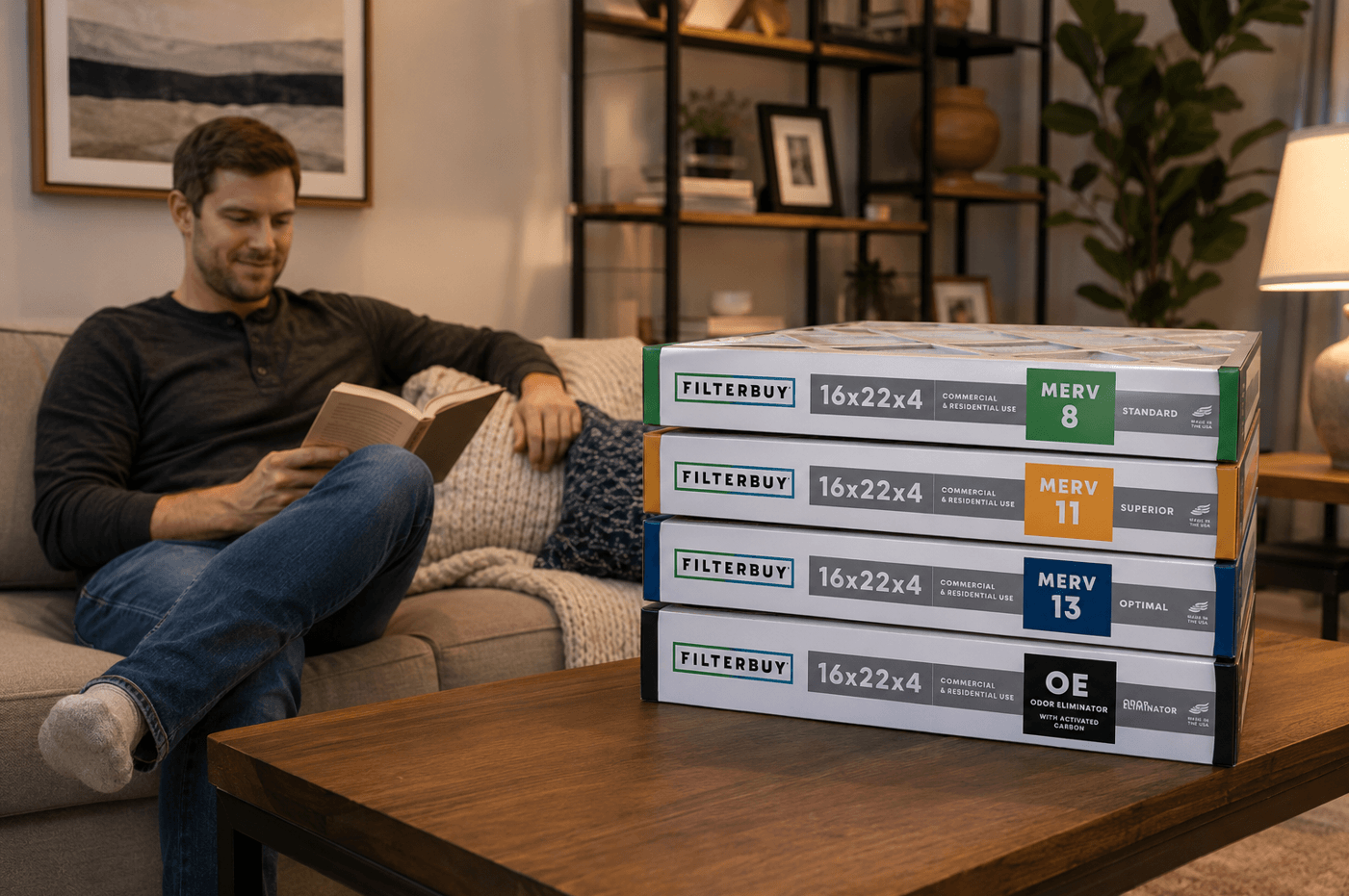
“Between checking my own system's pressure spec and learning to measure the old filter instead of trusting the label, how I shop for this size changed completely. Neither one is obvious until someone tells you to look.” - Viola Deeley
Essential Resources on 16x22x4 Air Filters
I didn't just pull the first seven results a search engine handed me. I read each one against what I'd already found on my own system's spec panel, and cut anything that just repeated the "bigger MERV is better" line without addressing airflow. These seven are the ones that actually changed how I'd answer a specific question.
See Every Filtration Option Before You Buy
Before committing to a 4-inch filter, it's worth seeing the full menu of options side by side. The EPA's consumer guide to air cleaners lays out portable air cleaners and HVAC filters together so you can compare what each one actually does before you spend money on either.
Source: U.S. EPA
Confirm Your Filter Change Habits Aren't Costing You
A 4-inch filter only pays off if the rest of your system maintenance keeps up with it. ENERGY STAR's maintenance checklist spells out exactly what a contractor should be checking each season, including the filter, so you know whether a bigger filter is solving your problem or just masking a different one.
Source: ENERGY STAR
Get the Installation Details Manufacturers Skip
Filter depth means nothing if the filter isn't sealed into the cabinet correctly. The Department of Energy's Building Science Education guide to HVAC filter installation covers where filters belong in the system and why a poor seal lets unfiltered air bypass the media entirely- gaps I didn't think to check on my own setup until I read this.
Source: U.S. Department of Energy
Understand Why More Surface Area Means Less Strain
This is the mechanic behind everything discussed above, explained in more technical depth. NAFA's filter efficiency guide shows how filters with more pleated surface area reduce pressure drop, the same principle that makes a 16x22x4 filter behave differently than a 1-inch filter at the same MERV rating.
Source: National Air Filtration Association (NAFA)
Learn How Filtration Affects the Air You Actually Breathe
Energy savings are only half the reason filter choice matters. The CDC's overview of ventilation and filtration explains how filtration reduces airborne particle concentrations indoors, which is the health case for not just defaulting to the cheapest filter that fits.
Source: CDC / NIOSH
Check the Official Residential MERV Recommendation
If you want the standards body's own answer instead of a secondhand summary, ASHRAE's technical FAQ on residential filtration states the minimum MERV recommendation for homes directly and flags why airflow resistance has to be checked before upgrading.
Source: ASHRAE
See How High a MERV Rating Actually Needs to Be
For a concrete sense of what different MERV ratings you buy, the indoor air filtration factsheet co-published on AirNow.gov breaks down particle reduction by MERV range, useful context for deciding whether MERV 8, 11, or 13 is the right call for a 16x22x4 slot.
Source: AirNow.gov (U.S. EPA)
Supporting Statistics
Three numbers I kept coming back to while researching this, because each one changes how I'd answer "is a 16x22x4 filter actually worth it" for a specific kind of household.
Heating and air conditioning account for 52% of a typical U.S. household's annual energy use, more than every other category combined. This is the number that makes the airflow-resistance argument matter in the first place: if HVAC weren't already the single biggest line item on the energy bill, a filter's effect on blower load wouldn't be worth this much attention.
Source: U.S. Energy Information Administration
A 4-inch-deep pleated filter carries roughly twice the surface area of a 2-inch filter, and in side-by-side manufacturer testing, that translated to a lower pressure drop (0.12 in. w.c.) than both a 2-inch (0.13 in. w.c.) and a 1-inch (0.20 in. w.c.) filter of the same MERV rating at the same airflow. This is the specific data point behind everything I said earlier about surface area and blower strain; it's not a rounded-off industry rule of thumb, it's a measured comparison at a matched MERV rating.
Source: U.S. Department of Energy, Building America Solution Center
8.2% of Americans, or 26.8 million people, were living with current asthma as of 2022. I didn't fully appreciate how large that population is until I saw the number next to the MERV-and-allergen data in this piece; it reframes the MERV-rating decision from a comfort preference into something a meaningful share of any household might actually need.
Source: American Lung Association
Frequently Asked Questions
Does a thicker filter always mean better efficiency?
Not automatically, and this is the assumption I had to unlearn myself. The efficiency gain comes from lower airflow resistance at a given MERV rating, which a 4-inch filter's larger surface area makes possible, but only if your system is designed or retrofitted to accept that depth.
How often should I change a 16x22x4 filter?
Most manufacturers suggest every 60 to 90 days for a 4-inch filter, versus 30 days for a standard 1-inch filter, though household dust, pets, and usage all shift that timeline.
Can I put a 16x22x4 filter in a slot built for a 1-inch filter?
No. A 4-inch air filter needs a media cabinet or filter housing sized for that depth. Forcing a thicker filter into a slot it doesn't fit can leave gaps that let unfiltered air bypass the media entirely.
Will a 16x22x4 filter I order actually measure 16 by 22 by 4 inches?
Probably not exactly, and that's normal. 16x22x4 is a nominal size; manufacturers build the actual filter slightly smaller so it fits the frame without binding. Measure your old filter directly rather than trusting the label alone, especially on a less common size like this one where a wrong order is more of a hassle to return.
I keep coming back to the same conclusion: the filter size only helps if it's solving an actual airflow problem in your specific system, so it's worth a quick look at your equipment specs before assuming bigger is automatically better.
Ready to See If a 16x22x4 Filter Makes Sense for Your System?
If a dirty or undersized filter has been quietly working against your HVAC energy efficiency, swapping to a 16x22x4 filter is one of the simplest ways to find out. Check your filter slot depth today, and if a 4-inch cabinet is already in place, this 16x22x4 filter lineup is a solid place to start.
Glossary
MERV (Minimum Efficiency Reporting Value): A 1 to 16 rating scale showing how well a filter captures particles between 0.3 and 10 microns. Higher numbers mean finer capture.
Static pressure: The resistance air encounters as it moves through ductwork and a filter. High static pressure forces the blower motor to work harder.
Blower motor: The fan component inside an HVAC air handler that pushes conditioned air through the ducts; its workload rises directly with airflow resistance.
Filter media: The pleated material inside the filter frame that physically traps particles as air passes through.
Nominal size: The rounded, labeled dimensions of a filter (like 16x22x4). The actual manufactured filter runs slightly smaller in each dimension so it fits the frame without binding.
Media filter cabinet: A boxier housing attached to the return duct or air handler that holds a deep filter like a 4-inch model; distinct from the thin factory slot built for 1-inch or 2-inch filters.
Learn more about HVAC Care from one of our HVAC solutions branches…
Filterbuy HVAC Solutions - Miami FL - Air Conditioning Service
1300 S Miami Ave Apt 4806 Miami FL 33130
(305) 306-5027
https://maps.app.goo.gl/Ci1vrL596LhvXKU79